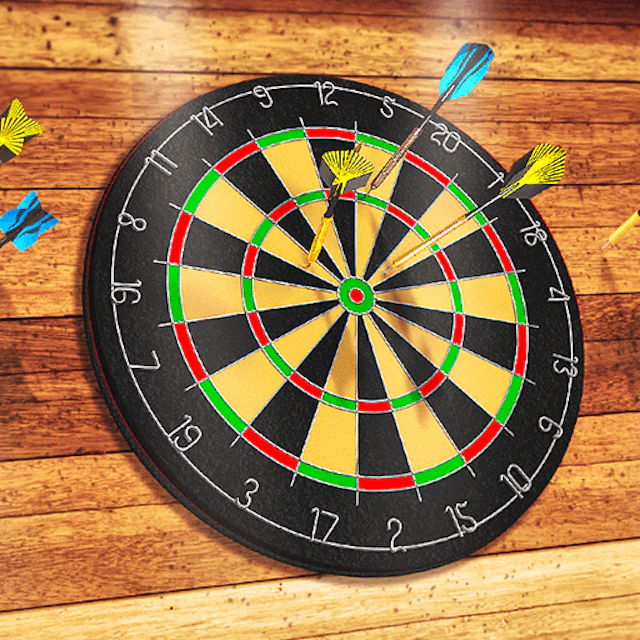
What changes when the dartboard is in 3D
A flat dartboard drawn on a screen gives you a clean top-down aim, so you can see the exact
line to the treble twenty. A 3D board removes that crutch. You are looking at the board from
a standing angle, which means judging depth as well as left and right, and the throw arc has
to be estimated rather than read off a straight line. The practical effect is that the
centre of the board becomes a safer target than the trebles, at least until your aim settles.
Aim small, release consistently, and treat the first few throws as calibration.
Standard darts scoring: 501, doubles and check-out
In 501 both players start at 501 and subtract each throw, and the first to reach exactly zero
wins. The catch is the double: the winning dart must land in the outer double ring of the
number you need, so 40 is finished with a double twenty, not two twenties. Going below zero,
or reaching zero on a single, busts the turn and restores your previous score. Cricket works
differently — you close numbers 15 to 20 and the bull, then score points on numbers your
opponent has not closed. For a board to practise on, try
Darts Pro Multiplayer or
browse all darts games on QuikDen.
Frequently asked questions
How does scoring work in darts?
Each number scores its face value, tripled in the inner ring and doubled in the outer ring, with the bull worth 25 and the inner bull 50. In 501 those points are subtracted from your starting score.
What is a checkout in darts?
A checkout is the sequence of darts that takes you from your remaining score to exactly zero, finishing on a double. A common example is 40, finished with a single dart in the double twenty.
Is 3D darts harder than a real dartboard?
It is harder in a different way. You do not have to control a physical throw, but you do have to judge depth and angle from a fixed viewpoint, which makes the treble ring less reliable than it looks on a flat board.